

What is Dark Web Monitoring and Why You Need It for Identity Protection
Dark web monitoring is a proactive cybersecurity service that continuously searches hidden internet spaces for personal data tied to your identity and accounts, alerting you when credentials or sensitive information appear so you can act quickly to limit harm. Early detection through a dark web scan reduces time-to-detection for stolen credentials and lowers the chance of identity theft, financial fraud, and account takeover. This article explains what dark web monitoring is, where exposed data appears, and how detection technology works in plain terms, then details the practical benefits for individuals and businesses. You will also find clear steps to take after an alert, a comparison table showing who benefits most from monitoring, and a brief note on how remediation and remote tech support integrate with monitoring workflows.
What is Dark Web Monitoring and How Does It Protect Your Personal Data?
Dark web monitoring means scanning hidden networks and illicit marketplaces for data that matches your email addresses, usernames, or other identifiers, then notifying you so you can remediate compromised accounts. The process protects personal data by shortening the window between theft and response, preventing attackers from exploiting stolen credentials. Monitoring focuses on credential monitoring and personal data leak detection rather than broader endpoint defenses, complementing other cybersecurity controls. Understanding the scope of scanned data leads to examining what the dark web actually contains and why stolen records surface there.
Understanding the Dark Web: Hidden Risks and Illicit Activities

The dark web is the portion of the internet accessible via anonymizing tools where threat actors trade stolen data, malware, and illicit services, distinct from the searchable surface web and the private deep web. Criminal marketplaces, closed forums, and paste sites often host bulk data dumps from breaches, which is why personal information like login credentials and payment data can surface there. Recent trends show a steady flow of harvested credentials moving through these channels, increasing the chance an exposed email or password affects real accounts. Knowing these risks clarifies why continuous scanning and credential monitoring are necessary to limit exposure and prompt defensive action.
How Dark Web Monitoring Detects Stolen Credentials and Data Breaches
Monitoring relies on automated crawlers and threat intelligence feeds that collect postings, data dumps, and forum chatter, then match those findings against customer identifiers using exact and fuzzy matching techniques. Systems compare email addresses, username patterns, password hashes, and structured PII patterns to detect likely matches while applying verification to reduce false positives. Verified findings generate prioritized alerts that indicate confidence, type of data found, and suggested next steps for containment. That verification stage is critical because it turns noisy raw data into actionable stolen-data alerts for users and administrators.
What Are the Key Benefits of Dark Web Monitoring for Individuals and Businesses?
Dark web monitoring delivers early warning, reduced fraud risk, and improved incident response readiness for both individuals and organizations by surfacing compromised credentials before attackers exploit them. The service acts as a form of identity protection service that complements credit monitoring and endpoint security, giving a distinct advantage through proactive dark web intelligence. Below are practical benefits that apply across personal and corporate use cases and a comparison table to show how impact differs by beneficiary type. After reviewing benefits, we’ll briefly explain how remediation and remote support can close the response loop.
Dark web monitoring provides these core advantages:
- Early Compromise Detection: Detects stolen credentials before attackers act, enabling rapid remediation.
- Reduced Financial Loss: Alerts help prevent unauthorized transactions and account takeover.
- Regulatory & Compliance Support: Businesses gain evidence of proactive monitoring that aids breach response.
- Peace of Mind: Continuous monitoring reduces uncertainty about unseen exposures.
These benefits make monitoring a key part of a layered cybersecurity strategy and lead naturally to how different users should respond when alerted.
Different beneficiaries face different typical exposures and responses; the table below compares Individuals versus Businesses to clarify expected findings and recommended actions.
| Beneficiary | Risk Detected | Typical Data Found | Recommended Response |
|---|---|---|---|
| Individual | Compromised accounts and personal data leaks | Email addresses, passwords, partial SSNs, card fragments | Change passwords, enable MFA, monitor bank statements |
| Small Business | Employee credential leaks and compromised vendor access | Corporate emails, VPN credentials, API keys | Rotate credentials, review access logs, contain affected systems |
| Enterprise | Large-scale data exfiltration and credential stuffing vectors | Bulk user records, hashed passwords, internal secrets | Incident response mobilization, forensic analysis, regulatory notification |
This comparison highlights how monitoring tailors recommended responses based on scale and impact, which informs the next section on immediate actions to take after an alert.
Preventing Identity Theft and Financial Loss through Early Alerts
When an alert arrives, immediate mitigation reduces harm: for individuals that means changing passwords, enabling multifactor authentication, and checking financial statements; for businesses the response includes credential rotation, access review, and breach scope analysis. A concise checklist helps prioritize actions so you move from notification to containment effectively and within minutes rather than days. Quick action commonly prevents unauthorized purchases and account takeover because attackers rely on time gaps between theft and detection. These practical steps connect directly to broader breach detection strategies and the technologies that make monitoring effective.
- Change Account Passwords: Update passwords for affected accounts using unique, strong passphrases.
- Enable MFA: Add multifactor authentication on all critical accounts to block hijacked credentials.
- Monitor Financial Activity: Review recent statements and place alerts on suspicious transactions.
Prompt remediation minimizes downstream financial and reputational damage, prompting the need to understand the monitoring workflow that produces these alerts.
Enhancing Cybersecurity with Proactive Data Breach Detection
Integrating dark web intelligence into an incident response plan reduces dwell time by alerting defenders to external signs of compromise earlier than many internal detections. Monitoring acts as an early external sensor that complements patching, access controls, and endpoint defenses to form a coherent security posture. For organizations, this means faster containment and reduced probability of lateral movement, while for individuals it translates to fewer successful account takeovers. The next section explains the technical steps behind those early warnings so you can see how monitoring translates into action.
How Does Dark Web Monitoring Work: Technology and Process Explained
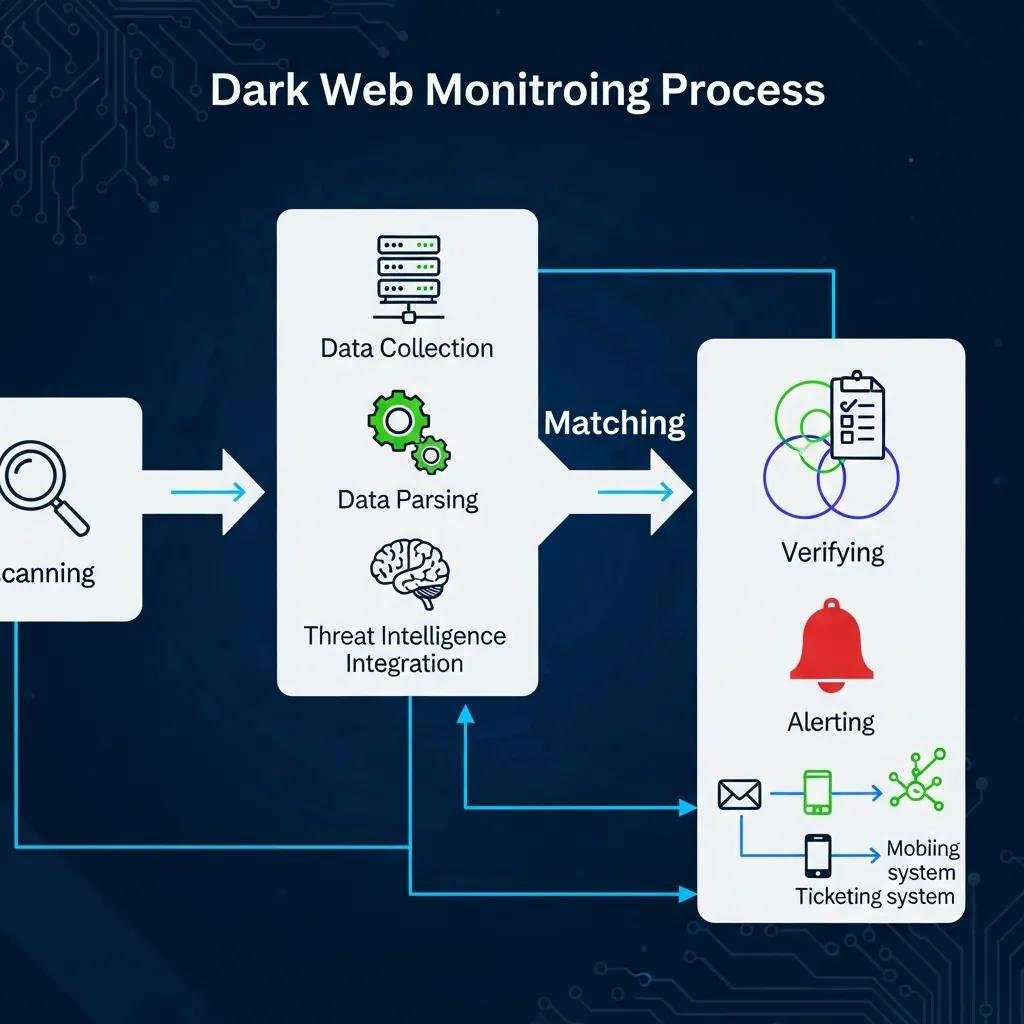
Dark web monitoring follows a repeatable operational workflow—scan, match, verify, alert—that combines automated collection with analytic prioritization so responders get timely, relevant notifications. Scanners gather data from marketplaces, forums, paste sites, and other dark web sources; matching algorithms link gathered items to customer identifiers; verification filters confirm relevance; and alerting systems deliver prioritized guidance for response. This stepwise process supports SLAs for notification and integrates with remediation workflows to close the loop between detection and cleanup. Understanding these steps clarifies how technical components map to practical security outcomes.
Below is a concise numbered process describing how monitoring typically works:
- Scan: Automated crawlers collect postings and data dumps across hidden networks in near-real time.
- Match: Matching engines compare harvested data against identifiers like emails and hashed passwords to find likely exposures.
- Verify: Analysts or automated verification reduce false positives and assess confidence before escalation.
- Alert: Prioritized alerts are delivered with recommended remediation steps and risk context.
This ordered workflow underpins the technical components in the table below and leads into how real-time intelligence and alerts present themselves to users.
| Component | Data Sources | Response Actions |
|---|---|---|
| Scanning Engine | Marketplaces, forums, paste sites, Tor services | Harvest raw records for analysis |
| Threat Intelligence Feeds | Brokered data streams and historic dumps | Enrich matches and prioritize risks |
| Alerting System | Email, dashboards, API integrations | Deliver findings with remediation guidance |
This mapping shows how each component contributes to producing reliable stolen data alerts and sets up the final point about integrating monitoring with remediation services.
Real-Time Scanning and AI-Powered Threat Intelligence
Real-time scanning keeps watch for new postings while AI and machine learning improve match accuracy by recognizing patterns and reducing noise from irrelevant data. Machine learning models detect anomalies in dumps, prioritize likely breaches, and cluster related records so investigators can act efficiently. This intelligence reduces false positives and ensures alerts are meaningful, which is essential for both individuals managing online accounts and teams responding at scale. The benefits of AI-assisted monitoring lead directly into practical alert handling and remediation steps when exposure is confirmed.
Receiving Alerts and Taking Action Against Cybercriminal Threats
A useful alert contains the data found, confidence level, suggested immediate actions, and context about where the data was discovered, enabling rapid decision-making and prioritized response. For consumers, this typically means changing affected passwords, enabling MFA, and watching accounts; for businesses it triggers credential rotation, access reviews, and possibly forensic analysis. Below is a short prioritized action checklist that helps recipients respond quickly and consistently.
- Contain: Isolate affected accounts and require credential resets.
- Verify: Confirm the exposure and assess confidence before wide escalations.
- Remediate: Follow recommended steps such as MFA enablement, password changes, and malware removal where needed.
Timely alerts plus clear action items compress the time from detection to remediation, which is where professional remote support can add value in complex or technical incidents.
Why Choose mcHelper.com's Dark Web Monitoring Services for Your Security Needs?
mcHelper.com is a remote computer repair and tech support company established in 2015 that offers 24/7 assistance for Mac and Windows users, including Computer & Internet Security and Virus & Spyware Removal. While dark web monitoring is focused on detection and stolen data alerts, mcHelper.com’s remote experts and annual support package can complement monitoring by providing fast remediation support when compromised systems or malware are discovered. Their “NO FIX – NO FEE” promise, round-the-clock availability, and expertise across platforms make engaging remote assistance a practical next step after a confirmed exposure.
mcHelper.com’s client-friendly features include:
- 24/7/365 availability of technical specialists for remote assistance.
- Remote access convenience to diagnose and remediate malware or security gaps.
- Affordable annual support packages that provide ongoing protection and peace of mind.
- “NO FIX – NO FEE” service promise that aligns cost to results.
These offerings let individuals and small businesses integrate dark web intelligence with hands-on remediation—engage remote experts to remove malware, restore secure settings, and guide credential recovery when monitoring reveals exposure.