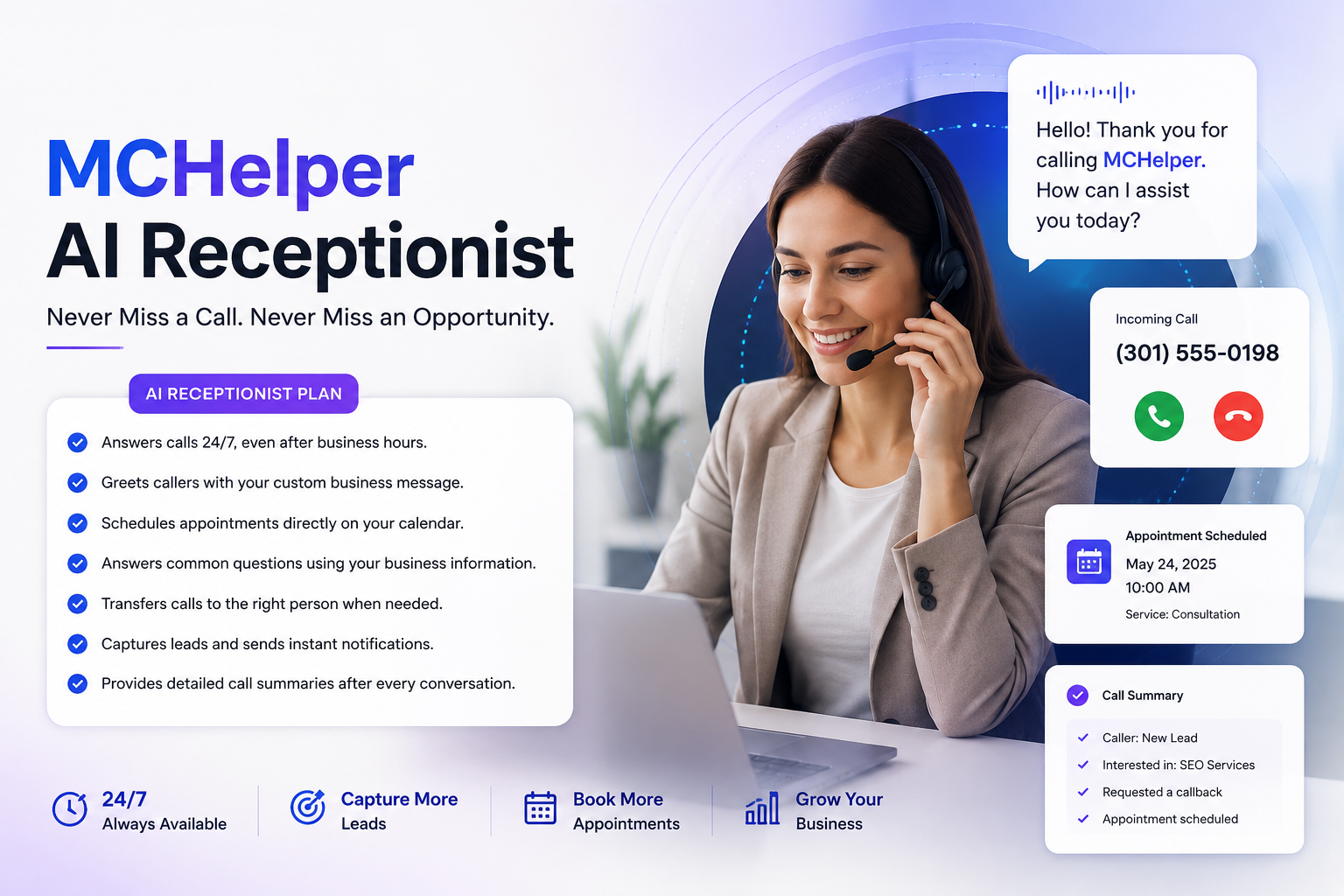

Before using an AI receptionist, decide which requests need a person, who will receive them and what happens if that person is unavailable. A written escalation policy gives staff a common reference. It is a business operating plan that must be checked against the actual service’s capabilities.
This guide offers planning questions for a small business considering MC Helper’s AI receptionist services. It does not assert that every transfer, summary, alert or integration described below is included or enabled. Confirm those details with the provider and test the agreed setup before relying on it.
Define the boundary of routine intake
List the requests the receptionist is allowed to handle and the information it may give. Then identify exceptions that staff must decide. Examples may include a caller asking for a person, a complaint, a disputed payment, an unusual request or a question outside the approved information.
Do not ask a receptionist to give professional medical, legal or financial advice. Businesses in those fields need appropriate professional review of their intake process. Emergency guidance should follow the business’s approved policy; an ordinary callback queue is not an emergency service.
Write each rule as an operational instruction
For every exception, record the trigger, responsible role, available hours, contact route and fallback. Prefer observable requests over assumptions about a caller’s emotions or an unverified system confidence score.
Trigger: The caller explicitly asks to speak to a staff member.
Owner: The role assigned to receive that request during the relevant hours.
Action: Attempt the agreed route only if the service supports it and staff are available.
Fallback: Explain the available next step and record a callback request, if that process is supported.
Closure: Assign a person to check that the request was received and acted on.
This example is a template, not a statement that a live transfer will always connect. A failed transfer, an unanswered phone and an incomplete intake each need an explicit next step.
Set expectations honestly
Decide what callers should hear before a handoff attempt and if it fails. Do not promise an immediate human response unless the business actually provides it. A receptionist answering at all hours does not mean that human staff are available at all hours.
Keep callback language consistent with staffing and opening hours. If no dependable response window exists, avoid inventing one. Explain how the caller can contact the business again and how the request will be handled under the approved policy.
Agree on the minimum handoff information
Specify only the information staff need to respond, such as the caller’s preferred contact method and a brief reason for the request. Confirm spelling or numbers where appropriate. Identify information that should not be collected through the receptionist.
Check whether a summary or transcript is actually available, who can see it and how staff will retrieve it. Do not assume an automatic transfer of full conversation history. Staff may need to confirm important facts again; the goal is a useful handoff rather than a guarantee that callers never repeat themselves.
Test the complete path
Use fictional callers and test details. Try an ordinary request, a request for a person, an unanswered transfer, missing contact information and a request outside scope. Observe the caller experience and the staff side, including whether a request reaches the intended owner.
Do not stop at a successful demonstration during office hours. Test the relevant after-hours fallback and any unavailable-contact scenario within the agreed setup. Record what actually happened, including delays or manual steps.
Give the policy an owner
Name a staff member responsible for maintaining contact details, checking unresolved requests and approving changes. Review the policy when staffing, opening hours or supported service features change, and after a missed handoff reveals a gap.
Keep a short version history: what changed, why, who approved it and how it was tested. This makes it easier to distinguish a policy issue from a technical failure without assuming every error can be solved by changing a prompt.
Questions to ask before relying on the setup
Can every call reach a person immediately?
Only if the agreed service and staffing arrangement support it. Plan for unanswered and unavailable contacts.
Will all conversation context arrive automatically?
Confirm the actual handoff method and test it. Do not assume a summary, transcript or screen alert is available.
What shows that escalation worked?
Evidence that the right staff member received the request and completed the required follow-up, alongside the caller-facing result, is more useful than a transfer attempt alone.